featured artist
Pérez Celis
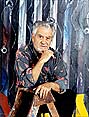



|
interview transcript
Date of Interview: Jun 01, 2001
Location: Argentina
Topic: Interview with Pérez Celis in Buenos Aires
Interviewer: LatinArt.com
LatinArt: What kind of statement are you making with your paintings?
Pérez Celis: In principle, I have said that I have always been unconscious, I let myself flow with the tides, and the same happens with my work in itself. Because no matter what the artist intends, what is actually going to emerge is something from the very "inside", very deep, and which may not be bound by some previous thought. What I’m saying is serious, and it must be handled with care. I believe an artist who is sensitive in himself, will unavoidably transmit what he lives, what surrounds him, and in this case, we know that we are living in a world with lots of troubles of all kinds, financial, social, in which one may not be exempted from them; there are artists who give us pretty clear testimonies of that. I am not referring simply to those making pamphlets, but to those conveying something much further and deeper, experiences that they are going through. If it is real, what I live will only arise from what I feel. This belief gives me the conviction not to think about what it is that I’m going to convey, but to insist on it.
LatinArt: What are you looking for in the surface and quality of your paintings?
Pérez Celis: To begin, I would like to add that I, as Picasso said, do not search, I find. I believe an artist may not seek, as it leads in many cases to a diversion from his own self. I believe one must be alert and receptive in order to find that which comes across. And that is why I have different stages.
LatinArt: Can you give us a brief description of your construction of negative and positive space in your work?
Pérez Celis: Since I don’t use theories in my work, I feel space in different ways. For example, there was a time when I used to visit the Pampa a lot, and then, I would unavoidably divide pictures in two. Since, in the Argentinean Pampa the horizon is essential, the horizon was like an element which, regardless of my will, kept on intruding in my work and I would inevitably make that kind of division. I visited Caracas where the horizon is practically nonexistent, but where there is a strong vertical presence, that horizontal line became vertical, and even, some time later, I divided planes vertically, as I've been doing recently, and which may be seen in some of the works I included in my book, Planeta (Planet). I believe that there are parts of space in a work, different parts of space, which one places in opposition, so that the climate may sometimes be clearer. We all have a dual life. Why wouldn't such duality exist in art as well?
LatinArt: What can you tell me about the importance of color in your work?
Pérez Celis: What actually happens with my work is that I, in opposition to many artists, feel that style is a prison. I don't want to keep to a style. That is, to say I have to paint in this way because this is who I am. There is not one atom in our body that is like the other within a second's difference, thus, we are permanently changing and I am open to those changes and welcome them. I think that is what will be seen in the show I am preparing in the Palais de Glace in Buenos Aires. You will be able to see different stages, but what will be seen is that although I've changed a lot, I am always Pérez Celis.
LatinArt: Can we talk a little about your symbolism -what it means to you, which symbols you are using and where they derive from?
Pérez Celis: Well, as I said at first, I was influenced by American primitive symbology. My trips around Latin America have made me create works with more precise symbols. Currently, since I feel that what is important in a piece is to work with energy, I may use very simple elements, for example, this triptych which I made in honor of three women who were very important in my life. The first is my mother, my wife Sara--I married very young, when I was 18, and became a widower at 36, and then remarried, and after 24 years my second wife died. This show is a tribute to them. We can see that it comprises three very simple geometrical figures, a square, a triangle and a circle. I believe that a drawing may always, be it a geometrical or a figurative drawing, be a tree, a face, an apple. What is important is that there is always an excuse to transmit all that energy, which is finally what every artist achieves.
LatinArt: Do you usually draw before you paint?
Pérez Celis: I can make many previous notes, but I don't make sketches. When I get into the work, I can keep in mind some of the notes I made and I mark down the most important figures which will serve as starting point for the rest of the work, and which is then transformed as I am working on them.
LatinArt: Among the people you have met, who were the most influential?
Pérez Celis: I was born in Buenos Aires, but from a very young age my destiny led me to travel around Latin America at first, starting in Bolivia, crossing Lake Titicaca, reaching Peru, settling in Lima, then Cuzco and finally, Machu Pichu. Later when I started studying at the academy, it was in response to all that. It was then that the influence of primitive American symbology began to take hold. This influence continued years later in Caracas, Venezuela where my images definitely changed. Mexico was another influence. When I finally had the chance of living a European experience in Paris, I changed again after visiting museums. Classicism had a profound impact in my work, until I realized at a certain moment that Europe was very interesting and that a lot could be learned, but that I missed the energy all America possessed, from Patagonia to Canada. So I changed again, settling in New York, more specifically in Soho, where I had my own studio for several years, and where I started to sense the energy and dynamics of a city like New York, but introducing the influence, those three great components Latin America has, which are: Indo-America, Afro-America and of course, Euro-America. I believe these three components are what my work conveys.
LatinArt: How does poetry reflect your philosophy regarding art?
Pérez Celis: My work is based on motivations, not on ideas that are "in" at this moment. I believe that ideas are great for advertising, but art must have something a lot more profound, something motivated. Two Cezanne apples or a portrait by Rembrandt, as ideas, are great ideas, but yet they have something deeper which renders them permanent. I believe this is where my motivation comes from. It has to do with the places I find myself and the places I’ve lived. I have been spending time in Miami for example and the light and color that a place as big as Miami has influences my work.
LatinArt: Lately, you have been creating huge sculptures, but you recognize yourself more as a painter. What made you create sculptures?
Pérez Celis: While in New York I already felt the need. In general, I have always worked with superimposed canvases and included elements in my canvases. My murals therefore, are more architectonic creations since I cannot conceive of a flat, smooth mural. I feel it is like an integration of wall and space. Somehow, I have always been experimenting with sculpture and in New York I started out with objects I found on the street, which told me something. In New York, you can find anything, so I took these objects back to my studio, modified them, and then I started sculpting. I had the chance of making a 16-meter tall sculpture in the city of Rosario, Argentina. The most recent one was for the Fortabat building, in concrete and steel. I believe that when an artist has an image inside, he can convey it in any way: from an etching, to a painting, a sculpture or a mural, he only has to adapt to the different materials.
LatinArt: What kind of feelings do you mean to include in your work?
Pérez Celis: I believe that the artist must not intend to include any emotions, but only to work, and what he is really living and feeling will come through. Thus, I generally observe the outcome and that’s where I discover just what I had not been able to see with my thoughts. Thought, as we all know, is the past. And creation is what is new, the unknown. Thought is born of knowledge, while creation is born from its counterpart, the unknown.
|

back to artists
|